Dhaulagiri and Hidden Valley Trek

Nepal
Annapurna Region
Duration

26 Days

Group Size

2-12 People

Grade

Difficult

Max. Altitude

8167 m

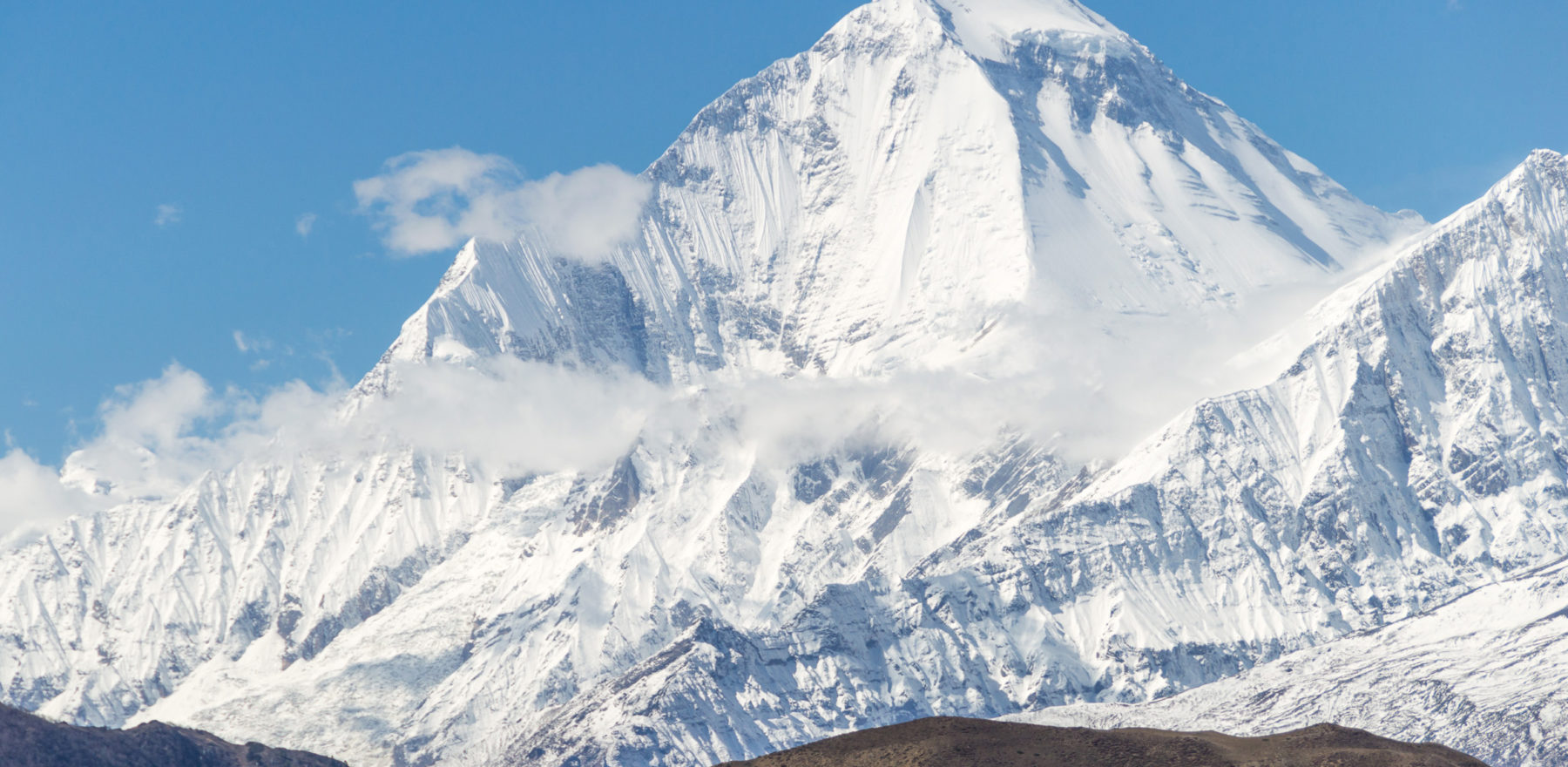
Dhaulagiri Massif (8,167m) – The 7th highest mountain in the world.
Hidden Valley – A remote, high-altitude desert plateau surrounded by snow-capped peaks
French Pass (5,360m) & Dhampus Pass (5,200m) – Challenging high-altitude crossings.
Spectacular panoramic views.
Dhaulagiri is one of the most popular 8000m Peaks for climbing in the Himalayas. The seventh highest mountain in the world, Dhaulagiri lies north – west of Pokhara culminating to its highest point at the eastern end. Dhaulagiri is almost unique in the world in terms of its rise above local terrain where it rises to 7000m over the Kali Gandaki gorge to the south east in about 30 km of aerial distance. In fact, Kali Gandaki is dramatic as two eight thousand Annapurna I and Dhaulagiri both stand near the river facing each other over a deep valley. Daulagiri was first discovered in 1808, and it was thought to be the highest mountain in the world for westerners. It was assumed the highest peak for 30 years before its place was taken by Kanchenjunga. Dhaulagiri literally means ‘white mountain’ which justifies a magnificent peak rising as a giant shoulder of shining ice and snow.

Places you'll See

Highlights

Highlights of the Trek

  • Dhaulagiri Massif (8,167m) – The 7th highest mountain in the world.

  • Hidden Valley – A remote, high-altitude desert plateau surrounded by snow-capped peaks.

  • French Pass (5,360m) & Dhampus Pass (5,200m) – Challenging high-altitude crossings.

  • Diverse Landscapes – From subtropical forests to glacial moraines and alpine meadows.

  • Off-the-Beaten-Path Experience – Fewer trekkers compared to Everest or Annapurna.

Difficulty & Challenges

  • Strenuous – Long days, high altitude, and technical sections.

  • Glacial Crossings – Requires experience with crampons/ropes in some sections.

  • Altitude Risk – Proper acclimatization is crucial.

  • Remote & Isolated – Limited teahouses; camping required in some areas.

Best Time to Trek

  • Spring (March-May) – Stable weather, blooming rhododendrons.

  • Autumn (September-November) – Clear skies, best visibility.


Map & Itinerary

It is a panoramic thrill flying into Kathmandu on a clear day. The views of snow-capped mountain peaks sprawling down below you are almost ecstatic, beginning a whole chain of memorable experiences that stay with you for a long, long time. A representative and driver from Explorer Nepal will meet you at the airport and escort you to Hotel. At the hotel you will be briefed about your daily activities.
Check In at the Hotel.
After breakfast at the hotel, commence the sightseeing tour of Kathmandu city, Swayambhunath and Patan city. Kathmandu City: Kasthamandap, the source of the name Kathmandu means ‘made from the timber of a single tree’. Also known as Kantipur, the capital Kathmandu is the hub of Nepal’s art and culture. It is a place for rest, relaxation and easy-day sightseeing of historic and artistic temples and monuments. Kathmandu Durbar Square with its arrays of temples, Seto Machhindranath and the ancient palace of the former Nepali Royals enriches your experience of the centuries old civilization. Swayambhunath Stupa: Said to be around 2000 years old, this Buddhist Stupa sits atop a hill. The main stupa is composed of a solid hemisphere of brick and earth supporting a lofty conical spire crowned by a pinnacle of Copper gilt. Painted on the four sided base of the spire are the all seeing eyes of Lord Buddha. The hill of Swayambhunath is a mosaic of small Chaityas and Pagoda temples. You’ll get a scenic view of Kathmandu city from there. Patan city: Located about 5 km south of Kathmandu, Patan is one of 3 royal cities in the valley. A destination for connoisseurs of fine arts, Patan is filled with wood and stone carvings, metal statues, ornate architecture, including dozens of Buddhist and Hindu temples, and over 1200 monuments. Patan is believed to have been built in the third century B.C. by the Kirat dynasty later expanded and enriched by the Licchavi and the Malla rulers in the medieval period. Patan Durbar Square, like its counterpart in Kathmandu, is an enchanting mélange of palace buildings, artistic courtyards and graceful pagoda temples. The former Royal palace complex is the centre of Patan’s religious and social life, and houses a beautiful museum. One remarkable monument here is 16th century temples dedicated to the Hindu go Krishna, built entirely of stone.
Check In at the Hotel.
From Kathmandu, we take a half an hour scenic flight to Pokhara or we drive for approx 6 hours to Pokhara. You can spend the later part of the day exploring Pokhara. Set amidst the spectacular backdrop of the Annapurna, Dhaulagiri and Machhapuchhre, the must visit sites of Pokhara include the Phewa Lake, Davis fall, Mahendra cave, the famous Seti Gorge, the beautiful temple of Bindabasini and Pokhara Mountain Museum.
After breakfast, we drive from Pokhara to Beni, from where our trek commences. The drive should take around 4 hours and it offers good scenic views. Beni is at the confluence of the Myagdi Khola and the Kali Gandaki Camp. Being the districts headquarter, Beni has a police check post where our trekking permits will be examined.
From Beni, we leave the Kali Gandaki and head west along the north bank of the Myagdi Khola through the village of Beni Mangalghat to Singa Bazar.
Today, from Singa Bazar we trek along the trail to Takum.
Today, after crossing a river, we head north to Phedi. As we leave, the trail starts climbing. We come across many switch-backs until we arrive at the ridge. The trail again climbs steeply up to Muri at 1850 m. Moving up along the trail, we trek to Sibang and Mattim. From here, continuing up an incline to the snout of a ridge, we descend to the Gatti Khola and reach Phalai Gaon (1810m). We then cross the Dhara Khola to again emerge on the west bank of the Myagdi Khola. After climbing a ridge, we finally reach the large Magar village of Muri. From Muri, we get amazing views of Mt. Dhaulagiri and other surrounding mountains.
After a short descend, we cross a stream and continue through terraced fields. Climbing a ridge, we reach the pass from where we can see Mt. Ghustung South (6465 m). Descending to the Myagdi Khola and trekking along its West Bank to the village of Naura, we climb for a short while. Traversing a grassy hill and climbing a steep slope with switch-backs, we then descend through a forest and terraced fields to reach Boghara (2080m).
Leaving Boghara, we continue along the trail. We descend through terraced fields to a small ridge and then through a forest to reach Jyardan. After the settlement, a high winding path crosses a rocky area and then descends before climbing up again to Lipshe where there is a single hut. The trail continues through a forest to Lapche Kharka and then climbs to Dobang. Today the path is quite difficult and sometimes we might need to use ropes.
Crossing a wooden bridge out of Dobang, the trail ascends a forested area. Passing through the beautiful forest, we rapidly gain altitude as mountains surround us. After crossing the Myagdi Khola, we later cross a stream to reach Choriban Khola. We continue along the trail (which is not very well defined) to the terminal moraine of the Chhonbarban Glacier and enter the glacier from the right. Tukche Peak (6837 m) becomes visible straight on at the far end, while the impressive north flank of Dhaulagiri I (8167 m) dominates the skyline to our right. After a short while we reach the Italian Base Camp (3660 m). To the west are the peaks of Dhaulagiri II (7751m), Dhaulagiri III (7715 m) and Dhaulagiri V (7618 m).
Today is a rest day for acclimatization.
Today, we trek along the trail to the Midway Camp. This trail is a little tough, so probably we might need to use a rope in a couple of tricky spots. The surroundings here are spectacular, with magnificent views of the beautiful snow-capped peaks.
Today is a rest day for acclimatization.
After proper acclimatization, today we climb steadily to the rough and chilling but spectacular Classic Base Camp at 5000m. This is a vantage point from where we get amazing views of the Dhaulagiri Ranges.
Today is a rest day for acclimatization.
After proper acclimatization, we climb two terraced hills before entering an ablation valley. We then climb to the French Col (5100 m) from where we can see Mukut Himal (6328 m), Tashi Kang (6386 m) and Sita Chuchura (6611 m). To the south is Tukche Peak (6920 m) and beyond is the massive peak of Dhaulagiri I. From French Pass we continue along the trail towards Dhampus Pass at 5200m. We camp below Dhampus Pass.
Today is a rest day but there is a possibility for us to climb the Dhampus Peak.
Today, after climbing over the 5200m Dhampus Pass, we traverse avalanche prone slopes and then descend steeply to Yak Kharka. From Yak Kharka, we continue along the trail to reach Alubari.
We now begin the descent down the dramatic Kali Gandaki Gorge. After passing through Jharkot and Khingar, villages with typical Tibetan architecture, we follow the valley floor most of the way to Jomsom. Jomsom is sprawled along both banks of the Kali Gandaki and from here we get fine views of the Nilgiri peaks. We continue down to Marpha, a delightful Thakali village, with a well-planned drainage system. Its narrow alleys and passageways provide welcome shelter from the strong winds of the Kali Gandaki Gorge. Marpha is particularly well known for its apples, apple cider and apple, apricot and peach rakshi.
We continue descending the Kali Gandaki Gorge to Tukuche, a Thakali village with a large gompa. Beyond Tukuche we walk along the west bank of the Kali Gandaki towards Larjung. Here, as in many of the villages in this area, narrow alleyways and tunnels connect houses with enclosed courtyards, providing protection against the wind blowing up the valley. We make our way through pine, juniper and cypress forests to Kalopani, enjoying fine views of Annapurna I and Fang. We then reach Lete, which lies just twenty minutes beyond Kalopani.
Our trail descends steeply through forests to Ghasa, the last Thakali village and the southern-most limit of Tibetan Buddhism. We enter the steepest and narrowest part of the gorge shortly after Ghasa. At the hamlet of Rupse a magnificent waterfall tumbles down beside the trail. Continuing on, we come to Dana, a Magar village from where the massive peak of Annapurna South can be seen across the valley. The trail then descends to Tatopani where we can have apple pie and bathe in the hot springs.
A short distance downstream from Tatopani, we cross the river on a large suspension bridge and leave the Kali Gandaki behind. After passing through the villages of Sikha and Chitre, we climb through the forest to Deorali, a 2834m pass from where we can get excellent views of Dhaulagiri, Nilgiri, Annapurna I, Annapurna South, and Hiunchuli. Just 10 minutes beyond the pass is the village of Ghorepani. Ghorepani literally means “horse water” and is a welcome watering spot for the packs of mules, which ply the route between Pokhara and Jomsom.
Overlooking Ghorepani is Poon Hill [3193m]. An hour-long pre-dawn ascent gives us the opportunity to see the fascinating views of the Annapurnas and Dhaulagiri glowing in the morning sun. After breakfast, we begin the long descent to Birethanti through magnificent oak and rhododendron forests. From the village of Ulleri, a long steep stone staircase seems to go on forever before eventually reaching Hille. A more gradual descent then brings us to Birethanti, from where it is a short distance to the road and our transport that takes us to Pokhara.
Fly back to Kathmandu. On arrival at Kathmandu airport meet, assist by our representative and transfer to hotel. PM: Free.
Overnight at Hotel.
Today is a day for relaxing. In the later part of the day, you can go for shopping, sightseeing or do whatever you please.
Our Nepalese support team will take you to the airport for your flight home.

What's included

Meet, assisted upon arrival at Kathmandu by our office representative.
All arrival / Departure transfers as per the itinerary by air-conditioned vehicle.
03 Nights twin/double room accommodation with breakfast at 3 star hotel in Kathmandu.
02 Nights twin/double room accommodation with breakfast at 3 star hotel in Pokhara.
Fully organize camping trek including all meals (breakfast, lunch and dinner) with Tea and coffee and hot water including guide and necessary support staffs with their insurance and salaries.
Necessary trek transfers as per the itinerary.
Kathmandu city tour as per the above itinerary with our local English speaking guide including monumental entrance fees.
Airfare for the sector Pokhara / Kathmandu with domestic airport tax and necessary airport transfers.

What's not included

Any meals in Kathmandu and Pokhara other than breakfast.
Travel insurance.
International air fare to and from Nepal.
Nepal Tourist Visa fees.
Items and expenses of personal nature.

Dates & Availability

Start Date
Price
Availability
01.03.2026-25.03.2026
from 7500 €
Book Now >
01.04.2026-25.04.2026
from 7500 €
Book Now >
01.05.2026-25.05.2026
from 7500 €
Book Now >
01.09.2026-25.09.2026
from 7500 €
Book Now >
01.10.2026-25.10.2026
from 7500 €
Book Now >
01.11.2026-25.11.2026
from 7500 €
Book Now >
01.12.2026-25.11.2026
from 7500 €
Book Now >
01.01.2027-25.01.2027
from 7500 €
Book Now >
01.02.2027-25.02.2027
from 7500 €
Book Now >
01.03.2027-25.03.2027
from 7500 €
Book Now >

Travel Notes

It is one of the moderate types trekking, because you are going above the 4156 meters at high. That’s why before you decide to do this trek you have to do some training. You will be walking 5 to 8 hrs a day; you need to have very good shoes. As you are going every day 500 to 1000 meters of altitude, you have to drinks lots of Water. During your trek you might get altitude sickness. Please read the symptoms of altitude sickness. If you have symptoms of ATS please tell our guide, so that he can take care of you.

List of things you need to bring: Dawn Jacket-1, Wind Proof-1, Gore-Tex-1, T-Shirt-4/6, Socks-4/6, Hat-1, Woolen Hat-1, Gloves-1pair, Trekking Boot-1Pair, Hiking shoe or Plipflop-1Pair, Raincoat-1, Water Bottle(1/2ltrs), Sunglass-1, Sun lotion, Towel, Thormel Trouser-2 pairs, Pool over-1, Sleeping Bag-1.

Best Months  to do this trek: Middle of September – November, Feb- April.

Rhododendron: Middle of March – April.
Contact us for any kind of information

Contact Information

Sher Bahadur Pariyar
Managing Director
+977 9851074484
Any questions about this trip? Call us and let’s plan your tour together!
Enquire Now
from
7500
Other Popular trips
Nepal
Royal Enfield- Bike Tour in Nepal
14 Days
Nepal
Please add a teaser description, so it can be displayed here!
17 Days
Nepal
Please add a teaser description, so it can be displayed here!
12 Days
Nepal
Less Touristic Trek - Makalu Base Camp Trek
21 Days
Nepal
The Tsum Valley Trek with Manaslu Circuit is a perfect blend of adventure, culture, and nature.
23 Days